Tuesday, May 15, 2012

Jasmine, Bush or Vine

     Although not every jasmine produces fragrant flowers, the sweet scent of the ones that do is possibly what your memory recalls whenever you think of this plant.
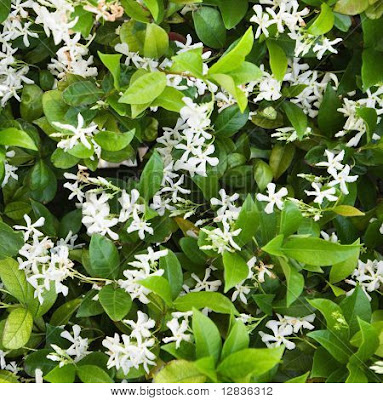
    Now weather you pick the bush or the vine is really a matter of what you like better. I think their both beautiful but I personally would go with the bush-I can always find room for a bush, but an arbor or something for a vine to grow up isn't as easy.
   Either way I'll tell you all you need to know to grow them:
    Instructions
1)Place your jasmine in full sun and out of low-lying areas, which trap cold air. While this plant tolerates light shade, it needs warmth.
2)Plant your jasmine shrub in a pot and take it out to the garden in the summer, unless you live in a tropical or subtropical climate. In that case, grow your jasmine outdoors year-round.
3)Space jasmine plants 8 feet apart in borders. 
4)Irrigate your jasmine shrub from the bottom if it's in a pot. Place the planter in a deep tray of water and let the soil absorb the moisture through the drainage holes. Allow it to dry between watering. 
5)Pinch off jasmine flower buds to encourage larger blooms and to control where the blossoms will appear.
6)Prune your jasmine plant throughout the year to control its growth and to keep it to the shape you want. In addition, cut branches that become entangled with one another just before spring growth begins. 
7)Dilute some indoor plant fertilizer to half strength and mix 1 gallon of the mixture with 1 tablespoon of liquid kelp. Water your jasmine plant and allow the excess water to run out of the drainage holes, if planted in a pot. Feed it 2 cups of the fertilizing formula you prepared. Repeat this step once a month. When it begins to get cool in October, reduce applications to ½ cup of fertilizer a month.
8)Bring potted shrubs indoors in the fall before the first freeze. Place them in a well-lit and warm location during the day, but which also gets dark in the evening. Exposure to the day's sun promotes foliage and flower production throughout the winter while the evening darkness encourages the plant to make new buds.
9)Repot the jasmine shrub in late spring. By then, your plant should have grown enough to need a planter one size bigger. In preparation for transplanting it, reduce the water and stop fertilization in early spring. When the plant is in its new pot, mulch the soil surface with compost and prune long branches to induce a bushy habit. Move the plant outdoors for another summer.
 Jasmine, the vine
Jasmine is a woody perennial vine grown outdoors in USDA Plant Hardiness Zones 8 through 10 and indoors in colder climates. Also known as Confederate Jasmine or by its scientific name of Trachelospermum jasminoides, the flowers have a pleasant jasmine fragrance and will grow on a fence or trellis.

Step 1
Locate the plants in full sun to partial shade if planted in the garden or in a container outdoors. The vine thrives indoors on indirect light throughout the summer but needs at least 4 hours of direct sunlight in the winter. Indoor plants can be placed outdoors in the summer, but don't place them in direct sun at first or they will burn.

Step 2
Water as soon the top of the soil feels dry during the spring and summer. Occasional misting should be done with distilled water when the air is particularly dry in the summer. In the fall, water the plant once every other week and cut back watering to once a month in the winter. Place indoor plants on a tray filled with pebbles and water. Do not allow the plant to sit directly in the water, just on top of the pebbles. This will provide the plant its required humidity.

Step 3
Apply a well-balanced fertilizer made for acid-loving plants once a month beginning in the spring. Discontinue fertilizing in mid-fall and begin again the following spring.

Step 4
Prune and thin straggly branches in the spring after blooming has finished to promote a bushier plant. In the winter, cut off any dead or diseased branches. Cut the plant back for shaping after the last frost. Do not cut more than 1/3 of the vine at any one time.

   Until we meet again.....


Monday, May 14, 2012

Lambs Ear's

    Hello friends, so yesterday I was at my mommy's and we all were digging up plants from her flower beds (my mother has a super green thumb and her plants were spreading like mad so we got to dig some up and take them home). 
   OK honest I just sat there while my kids dug them up for me-what it was mother's day! 
   Any way one of the plant's I wanted was Lamb's Ears, now I had them before at my old house but never had put any in this one. My kids loved "petting" them.
    I don't know if you've ever seen or felt these plants before but they are really sweet to have, yes they feel like a lambs ear and are more ground cover than a regular plant though they aren't classified as ground cover. Here's all the information.
     Requires a well-drained soil; doesn't require fertile soil. Plant in (ideal) full sun to partial afternoon shade (especially in hot and humid areas). If planted in too much shade, plants may have trouble with foliage problems. 
    Avoid getting water on the leaves, especially in the afternoon, since that may cause rot problems.   Because lamb's ear is not valued for its flowers(though I like the flowers), you may want to deadhead or remove flowers so that the foliage can be seen. 
    Prune out brown leaves or sections as needed, and new growth will fill in. Primarily propagated through division or seed. No serious problems with pests or diseases, but might have foliage disease when exposed to hot and humid conditions.
    You can put them in the front of your flower beds since they don't grow overly tall or put them in a place where you have trouble growing anything else(remember they will spread!). I've even seen them grown in pots, these plants are so easy going they don't care where you put them!

   These are really worth giving up some space for and are great for covering up ugly spots! Until we meet again....


Saturday, May 12, 2012

In Honor of Moms Everywhere

            Happy Mother's Day Friends!


Veronica and Jaxton

Veronica and Justice


Veronica and I after I married her and John
  I decided to put my daughter Veronica's picture in this because I'm so proud of her, she's an awesome mom.

 And this is my mom walking with Brock the only picture I have of her in my computer, it doesn't do her justice, she's a beautiful woman. Thanks Mom for always being there for me and my brothers-oh hell mom your whole family depends on you! Your so strong and wise. I love you Mommy.


Friday, May 11, 2012

An Evening Garden

    Hello friends, so I wasn't going to write about this until the space was completely done(OK so none of my garden is ever completely done)  
   Honestly I'm always adding or subtracting something from my flower beds. Besides I couldn't think of what to write about today and feel like I'm neglecting this blog
   I'm making my own secrete garden, but with a catch. It'll be pretty in the day time and at night, ya I've done some of this kind of garden before but this  is the real deal!
 Here's the list of flowers I'm using:
Annuals: 
Peace Pipe(Nicotiana)-A white summer blooming, (fragrant in the evenings), oval leafed and is about four feet tall, all zones.
Moonflower-Smells so good! It's part of the trumpet family, large oval leaves, ten feet tall, all zones.
Petunia(the Pearl Mix)- white flowers, summer blooms, one foot tall, all zones.

Moonflower at night
Moonflower closed day time


Peace Pipe


Petunia's
Perennials:
Daylily 'My Hope' A creamy trumpet shaped flower, blooms in the summer. Two feet tall and zones three to nine.
Variegated Miscanthus-A grass it has silver and white striped leaves, silver seed heads in the fall, six feet and zones five to nine.
White Dame's Rocket-White summer flowers,smells great at night,oval leaves, three feet tall, zones three to eight.
Hosta's 'Aphrodite'- White summer flowers(most Hosta's flowers are purple)large green leaves, two feet, zones three to nine.

White Dame's Rocket

Hosta's 'Aphrodite'

Variegated Miscanthus

Daylily 'My Hope'
   Now this fall I'll plant some Madonna Lily's, Gold banded Lily, Tuberose 'The Pearl' and Hyacinth. Not sure but I think I want to add some bushes too just haven't decided yet what kind-I'll let you know when I do. Until we meet again.....

P.S. Sinead the Latin name for Dancing Ballerina Bushes is Raphiolepis indica 'Ballerina'


 Where you can be free to be yourself, everyone needs to be heard.  http://bit.ly/IE2BIq